

Learning Center / Blackjack
How to play blackjackBeat the dealer to 21
The goal in blackjack is simple: finish closer to 21 than the dealer without going over. Winning more often takes basic strategy, and Las Vegas pros add card counting. Here is how blackjack is dealt, the rules that change your odds, and how to train both skills free in our blackjack trainer.
How a round of blackjack works
- Bet and deal
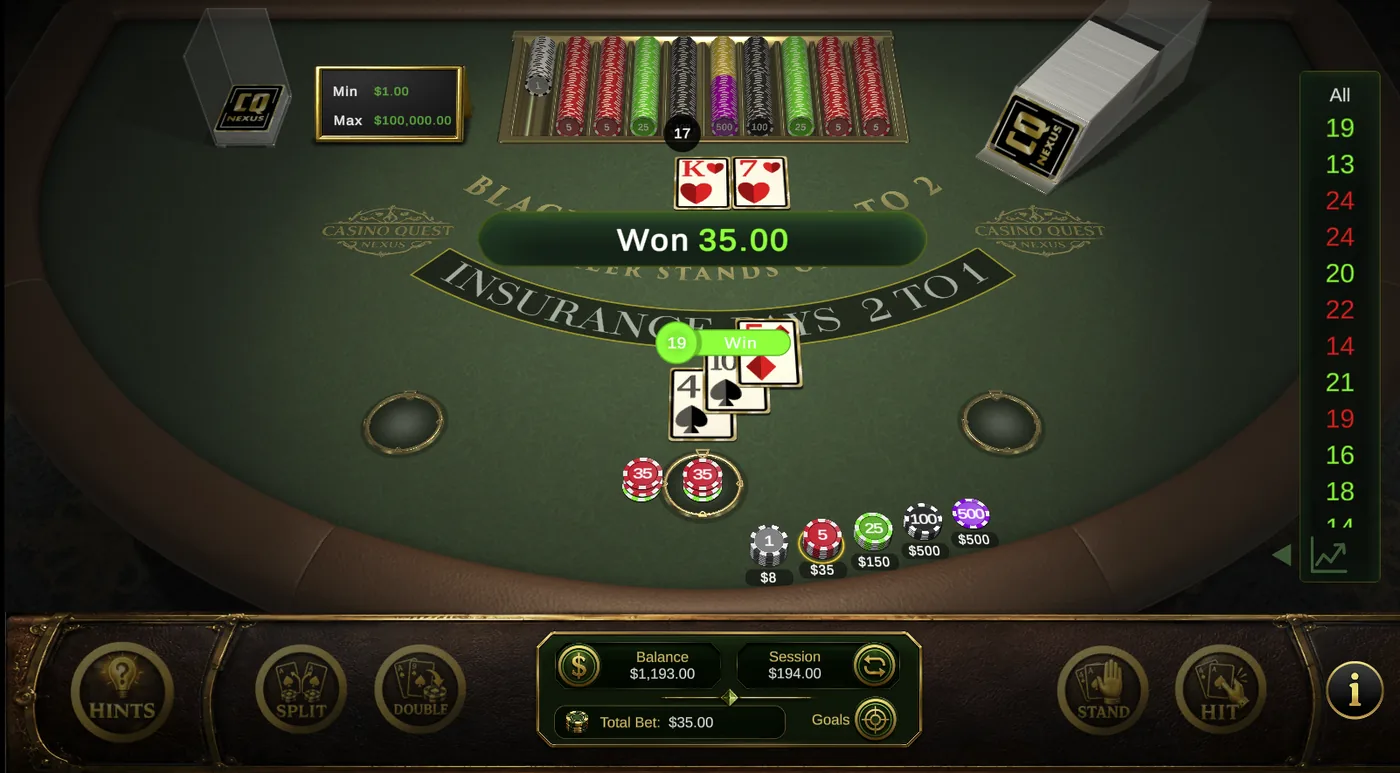
You and the dealer each get two cards. Yours are face up. The dealer shows one card and keeps one face down, the hole card.
- Count your hand
Cards 2 through 10 count face value, jacks, queens and kings count 10, and an ace counts 1 or 11. An ace with any 10-value card is a blackjack.
- The dealer peeks
With an ace or a 10-value card showing, the dealer checks the hole card for blackjack before anyone plays. With an ace up, insurance is offered first and pays 2 to 1.
- Play your hand
Hit for another card, stand, double down for one more card at twice your bet, split a pair into two hands, or surrender half your bet where the table allows it.
- The dealer plays
The dealer has no choices. They draw until 17. Some tables stand on soft 17 (S17) and some hit it (H17).
- Settle the bets
Beat the dealer and you win 1 to 1. A blackjack pays 3 to 2 (6 to 5 on some tables). A tie is a push.
Table rules that change your odds
Approximate effect on the house edge, versus a standard 6-deck Las Vegas game.
| Rule | Better for you | Effect |
|---|---|---|
| Blackjack payout | 3 to 2 instead of 6 to 5 | 6 to 5 adds about 1.4% |
| Soft 17 | Dealer stands (S17) | H17 adds about 0.2% |
| Double after split | Allowed | Saves about 0.14% |
| Surrender | Allowed | Saves about 0.08% |
| Number of decks | Fewer decks | Single deck saves about 0.5% |
Train the two skills that matter
Basic strategy
The mathematically best play for every hand against every dealer upcard. Played perfectly on good rules, it brings the house edge down to around 0.5%. Our Basic Strategy Trainer drills the chart until the decisions are automatic.
Card counting
Hi-Lo is the most common count: 2 through 6 are +1, 7 through 9 are 0, and 10s and aces are -1. Divide the running count by the decks left in the shoe to get the true count. Our Card Counting Trainer and live running and true count let you practice at your own speed.
Blackjack etiquette
The unwritten rules every dealer knows. Follow these and you'll play like a regular from your first visit.
- Put cash on the table
Lay it on the felt between hands. The dealer can't take it from your hand.
- Use hand signals
Tap the felt to hit and wave a flat hand to stand. The cameras record signals, not words, so dealers need to see them.
- Don't touch the cards in a shoe game
When cards are dealt face up from a shoe, leave them where they land. In hand-held games, hold cards with one hand and keep them over the table.
- Double and split beside your bet
Set the extra chips next to your original bet, never on top of it.
- Leave your bet alone
Once the first card is dealt, don't touch your chips until the hand is paid.
- Let others play their hands
Unasked advice is the fastest way to annoy a table, even when you're right.
- Watch for no mid-shoe entry
Some tables only let new players sit down after the shuffle. Check the sign.
- Tip with a bet
Place a small bet for the dealer in front of yours. If the hand wins, the dealer wins it too.
Blackjack terms
The words you'll hear at a blackjack table, in plain English.
- Blackjack
- An ace and a 10-value card as your first two cards. Usually pays 3 to 2.
- Upcard
- The dealer's face-up card.
- Hole card
- The dealer's face-down card.
- Hit
- Take another card.
- Stand
- Keep your total and take no more cards.
- Double down
- Double your bet and take exactly one more card.
- Split
- Turn a pair into two hands, each with its own bet.
- Surrender
- Give up half your bet and end the hand, where the table allows it.
- Insurance
- A side bet that the dealer has blackjack when an ace is showing. Pays 2 to 1.
- Bust
- Going over 21. The hand loses right away.
- Push
- A tie with the dealer. Your bet is returned.
- Soft hand
- A hand with an ace counted as 11, like ace-6 (soft 17).
- Hard hand
- A hand with no ace, or with an ace that can only count as 1.
- H17 / S17
- Whether the dealer hits or stands on soft 17.
- Basic strategy
- The mathematically best play for every hand against every dealer upcard.
- Running count
- The card counter's tally of high and low cards seen so far.
- True count
- The running count divided by the decks left in the shoe.
- Penetration
- How far into the shoe the dealer goes before shuffling.
- First base / third base
- The first seat dealt to, and the last seat to act before the dealer.
Blackjack questions
Can I play blackjack online for free?
Yes. Play blackjack free in your browser at games.cqnexus.com/blackjack with play money and no download. A 7-day free trial unlocks every feature, including the Basic Strategy Trainer and the Card Counting Trainer. CQ Nexus is a training app, so there is never any real-money wagering.
What is blackjack basic strategy?
Basic strategy is the mathematically best decision for every combination of your hand and the dealer's upcard: when to hit, stand, double, split or surrender. It does not guarantee a win, but on good rules it cuts the house edge to around 0.5%. The CQ Nexus blackjack trainer can coach every decision with toggleable hints.
Is card counting illegal?
No. Card counting with your own memory is legal in Las Vegas and across the US. Casinos are private businesses, though, and they can limit your bets or ask you to stop playing blackjack if they suspect you are counting.
Why does 3 to 2 versus 6 to 5 matter?
On a 3 to 2 table, a $10 blackjack pays $15. On a 6 to 5 table it pays $12. Because blackjacks come about once every 21 hands, the 6 to 5 payout adds roughly 1.4% to the house edge, more than any other common rule change.
Should I ever take insurance?
Basic strategy says no. Insurance is a side bet that the dealer has blackjack, and it loses money over time for a basic strategy player. Card counters take it only when the true count is high enough, usually +3 or more in Hi-Lo.
Can I play more than one hand at a time?
Yes. You can play 1 to 3 positions at once (first base, center and third base) and seat bots with their own strategies and bankrolls, so you can practice multi-hand blackjack the way a full table plays.
Ready to practice?
Video lessons for blackjack, narrated by the Casino Quest team, are coming to the Learning Center.